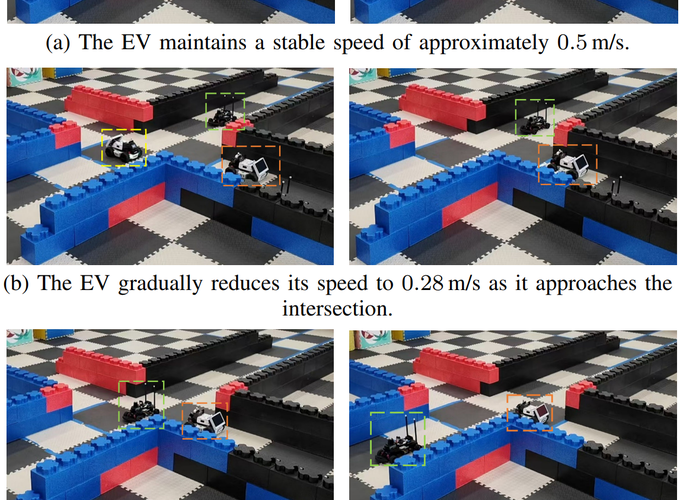
Ensuring safe driving while maintaining travel efficiency for autonomous vehicles in dynamic and occluded environments is a critical challenge. This paper proposes an occlusion-aware contingency safety-critical planning approach for real-time autonomous driving. Leveraging {reachability analysis} for risk assessment, forward reachable sets of {phantom vehicles} are used to derive risk-aware dynamic velocity boundaries. These velocity boundaries are incorporated into a biconvex nonlinear programming (NLP) formulation that formally enforces safety using spatiotemporal barrier constraints, while simultaneously optimizing exploration and fallback trajectories within a receding horizon planning framework. To enable real-time computation and coordination between trajectories, we employ the consensus alternating direction method of multipliers (ADMM) to decompose the biconvex NLP problem into low-dimensional convex subproblems. The effectiveness of the proposed approach is validated through simulations and real-world experiments in occluded intersections. Experimental results demonstrate enhanced safety and improved travel efficiency, enabling real-time safe trajectory generation in dynamic occluded intersections under varying obstacle conditions. The project page is available at \url{https://zack4417.github.io/oacp-website/}.
Supplementary notes can be added here, including code and math.