
Dynamic Neural Koopman Distillation for Real-Time Robot Control Using Diffusion Models
Distills diffusion robot policies into a Koopman-inspired latent dynamics model for millisecond-level real-time control.
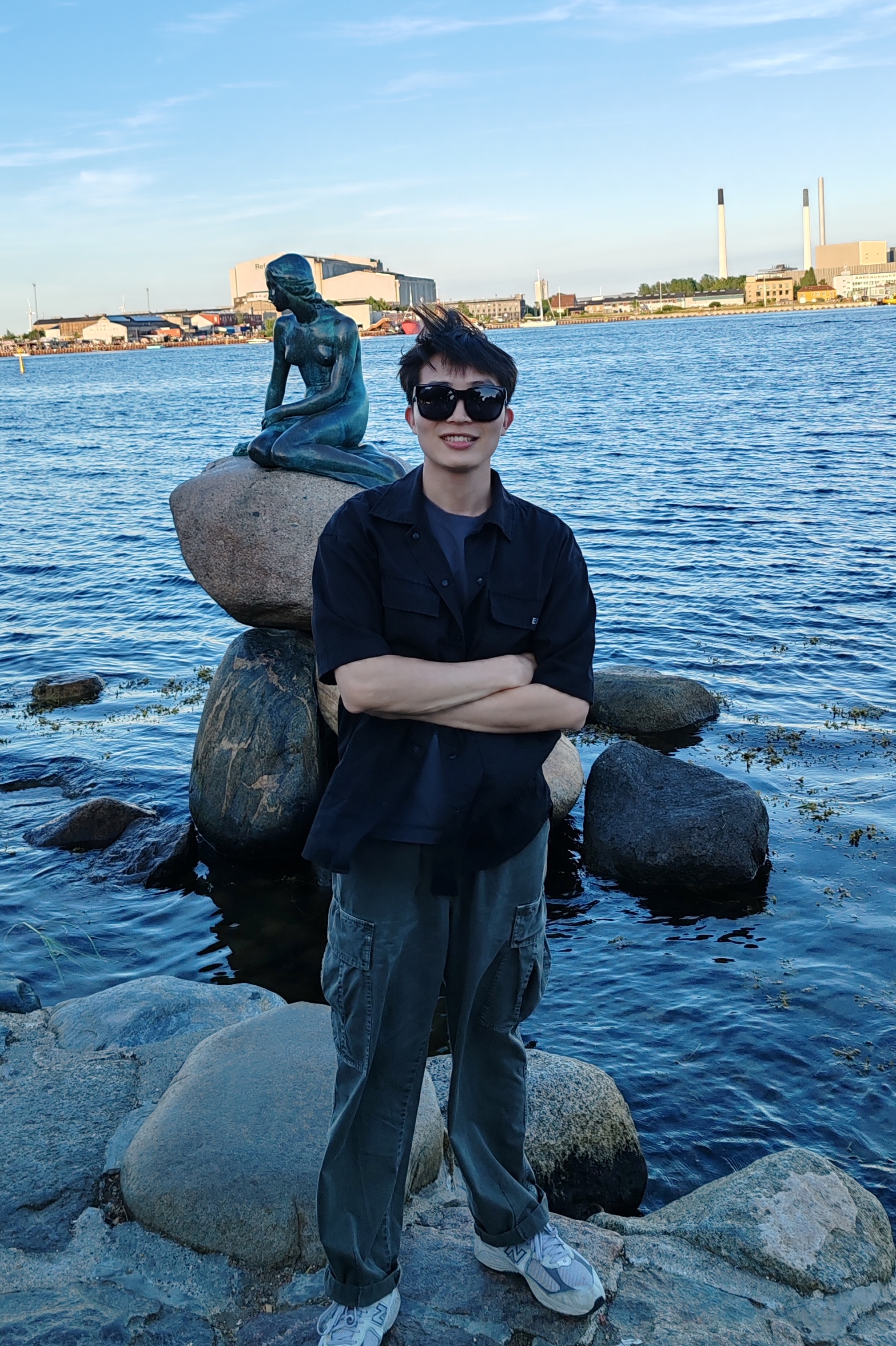
I am currently a Research Fellow with Prof. Armin Lederer in the Department of Electrical and Computer Engineering at the National University of Singapore. My research is dedicated to bridging theoretical advancement with practical application to create safe, reliable, and trustworthy autonomous systems.
I obtained my Ph.D. in Robotics and Autonomous Systems from The Hong Kong University of Science and Technology, supervised by Prof. Jun Ma and Prof. Michael Yu Wang. Prior to my doctoral studies, I worked as a Senior Robotics Engineer at XAG, where I spearheaded the development of a real-time trajectory replanning algorithm and a robust safe backup policy. These solutions have been deployed in products operating in over 60 countries and regions.
To deepen my expertise in fundamental robot safety, I was a Visiting Scholar at the Robotics Institute, Carnegie Mellon University (CMU), where I collaborated with Professor Changliu Liu.
Research Interests: My work lies at the intersection of theory and application:
Please contact me if you have any relevant positions or opportunities.
Download ResumeResearch on safe autonomy, planning, and learning

Distills multistep diffusion robot policies into a one-step Koopman student for millisecond-level closed-loop control. Validated on D4RL locomotion benchmarks and a physical Kinova Gen3 manipulator for obstacle-aware reconfiguration. Project page: fdkoopman.github.io.

This research introduces a occlusion-aware contingency safety-critical planning approach for safety-critical autonomous vehicles. Leveraging reachability analysis for risk assessment, forward reachable sets of occluded phantom obstacles are computed. The occlusion-aware contingency planner then constructs multiple locally optimal trajectory branches (each tailored to different risk scenarios), and a shared consensus trunk is generated to ensure smooth transitions and motion consistency.

To achieve high-speed autonomous flight of aerial vehicles and realize high-performance precision spraying in precision farming. Trajectories must be generated in real-time to avoid collision and be close to the reference spraying path. Because of the high navigation speed, short sensing range, and unknown environments, response time is extremely limited, making generating high-quality trajectories a significant challenge.
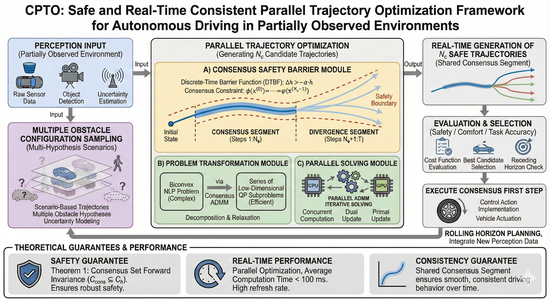
This research introduces a consistent parallel trajectory optimization (CPTO) approach for real-time, consistent, and safe trajectory planning for autonomous driving in partially observed environments. The CPTO framework introduces a consensus safety barrier module, ensuring that each generated trajectory maintains a consistent and safe segment, even when faced with varying levels of obstacle detection accuracy. We validate our CPTO framework through extensive comparisons with state-of-the-art baselines across multiple driving tasks in partially observable environments. Our results demonstrate improved safety and consistency using both synthetic and real-world traffic datasets.

Enforcing safety while preventing overly conservative behaviors is essential for autonomous vehicles to achieve high task performance. In this project, we propose a barrier-enhanced homotopic parallel trajectory optimization approach with over-relaxed alternating direction method of multipliers for real-time integrated decision-making and planning in cluttered driving environments. Through a series of experiments, the proposed development demonstrates improved task accuracy, stability, and consistency in various traffic scenarios using synthetic and real-world traffic datasets. We have also implemented our algorithms on an autonomous car, successfully achieving vehicle following, lane changing, overtaking, and cruise driving in dense traffic flow simulations based on ROS2.

Robust real-time trajectory generation for agricultural aerial vehicles to enable safe high-speed autonomous flight and precise spraying under short sensing range and unknown environments. Memory-efficient replanning supports smooth return and dynamic height adjustment, and extends to multi-agent safety-critical navigation for precision farming. Demo: YouTube.

Designed efficient incremental Gaussian Processes accounting for airflow uncertainties. The wind disturbance caused by the external environment is estimated to improve flight safety and control stability in cluttered environments. Following that, the estimated wind disturbance is used to compensate for the associated control error.

For safety-critical vehicles in mixed traffic flow where most vehicles are human-driven, each autonomous vehicle keeps tracking its front vehicle at a desired constant speed while maintaining a safe following distance with it in normal situations. However, when a vehicle decelerates urgently in unexpected situations, the vehicle behind has to reduce its speed to avoid collision with the front vehicle. In these cases, there exists a conflict between safety and stable high-performance tracking. For safety-critical autonomous vehicles, safety must not be violated and the tracking errors should be kept as small as possible.
Research & industry
Department of Electrical and Computer Engineering, with Prof. Armin Lederer. Contributing to an NUS Robotics Seed Grant collaborative project on long-horizon complex tasks for humanoid robots, developing learning-based safety filters that estimate safety boundaries and their uncertainty from visual perception and proprioceptive robot state in unstructured environments.
Collaborated with Prof. Changliu Liu on fundamental robot safety, spanning formal methods and learning-enabled safe control for autonomous systems.
Thesis research on safety-critical motion planning, occlusion-aware contingency planning, and trajectory optimization for autonomous vehicles. Supervised by Prof. Jun Ma and Prof. Michael Yu Wang.
Led real-time trajectory replanning and safe backup policies for agricultural UAVs; algorithms deployed in products operating in 60+ countries and regions.
Selected works on safe planning and learning-based control
Representative papers with a figure and short summary. For the complete list, see Publications.
Distills diffusion robot policies into a Koopman-inspired latent dynamics model for millisecond-level real-time control.
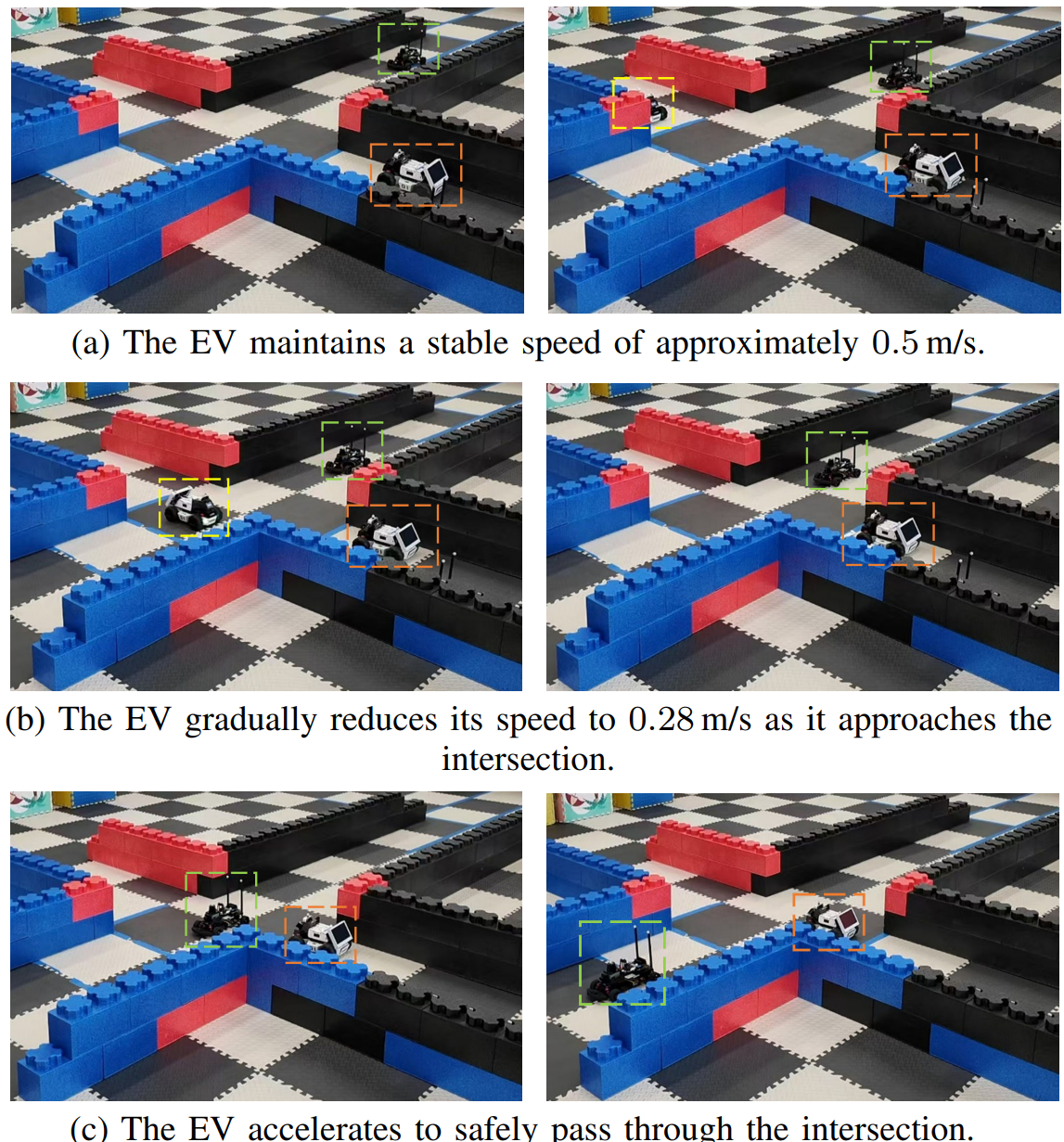
Contingency planning under occlusion uncertainty with consensus safety barriers for reliable autonomous driving.
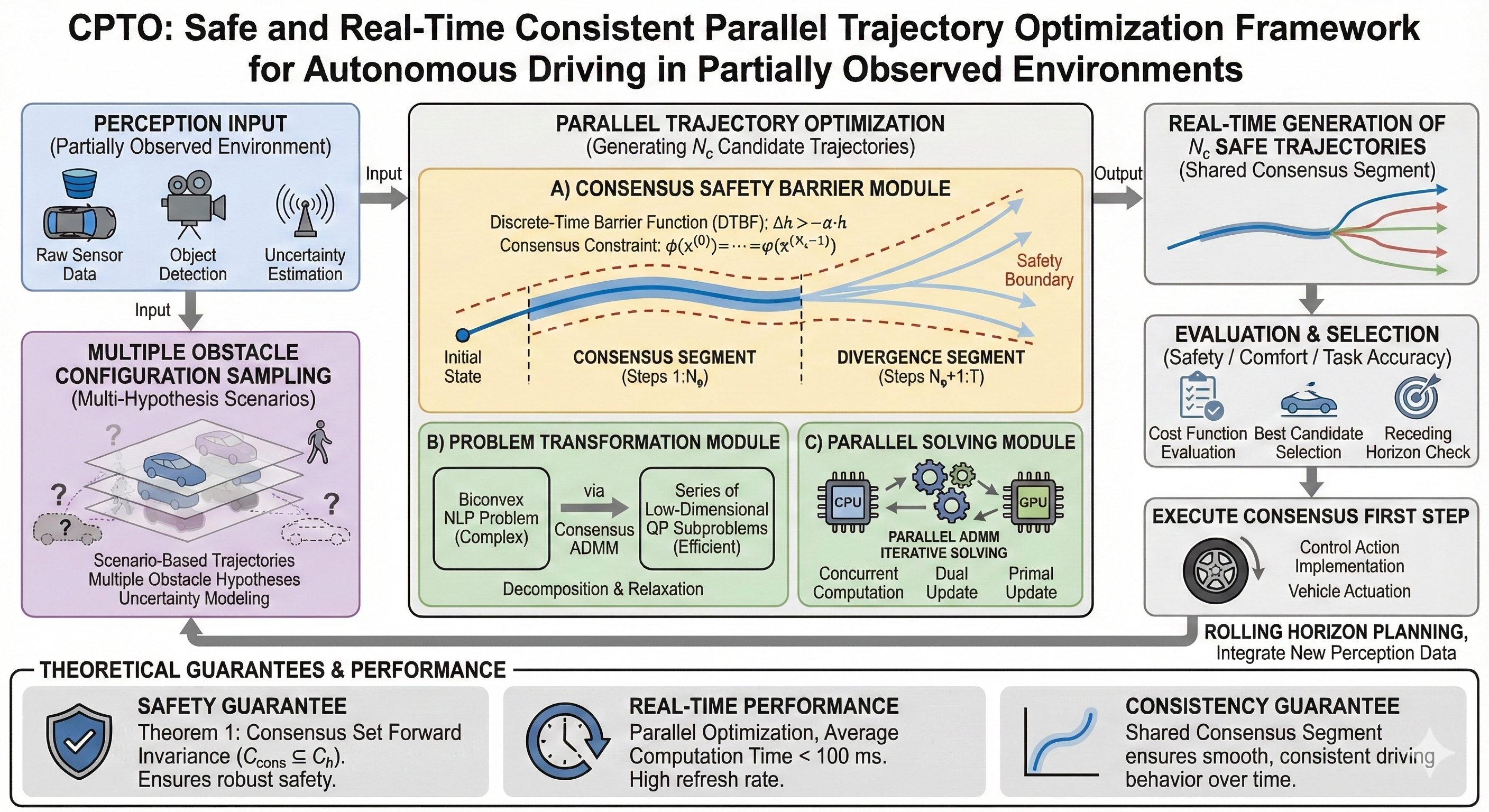
Parallel consensus optimization that keeps motion consistent and safe when perception is incomplete.
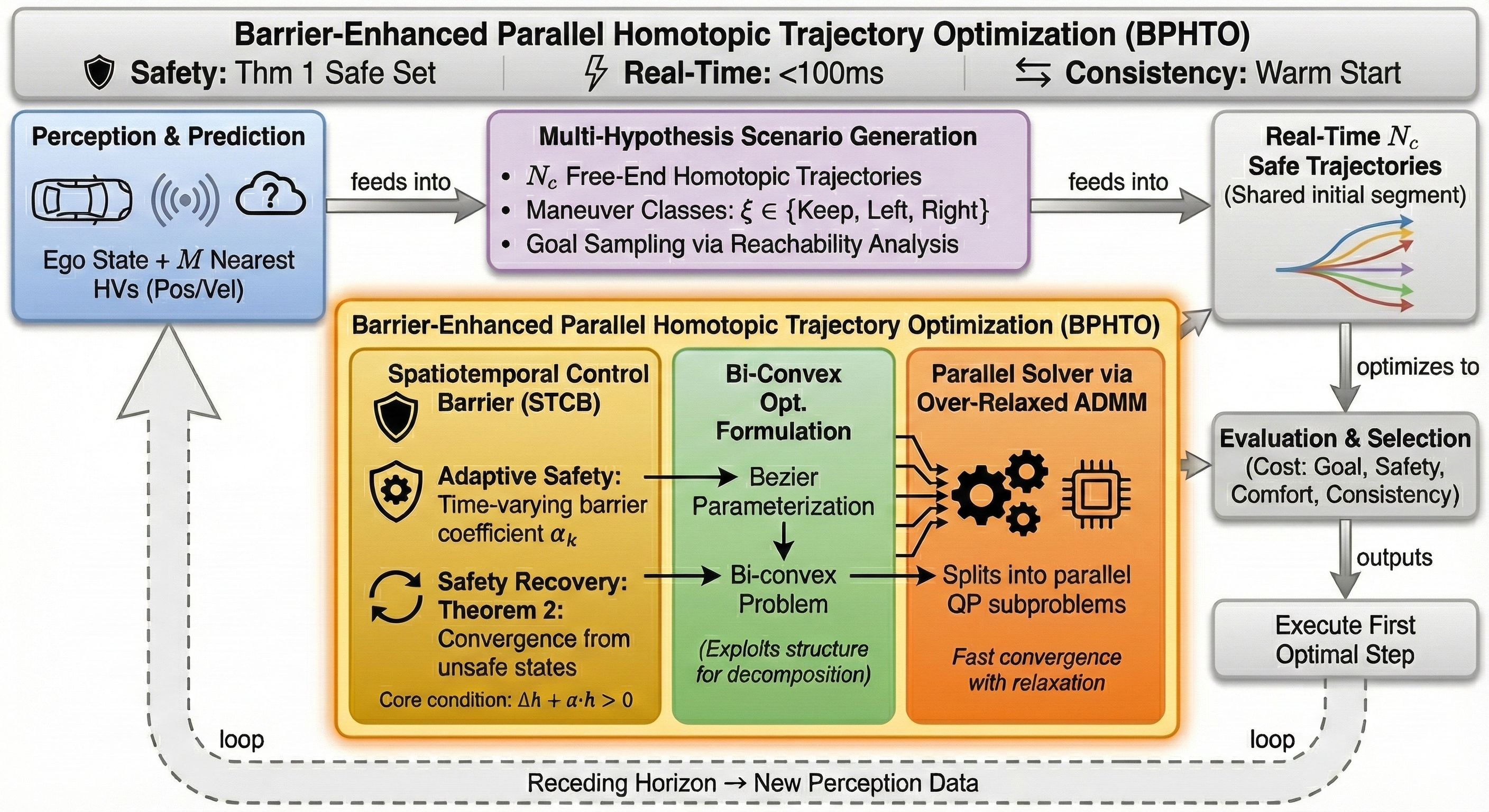
Homotopic parallel trajectory optimization with barrier enhancement for real-time decision-making in traffic.
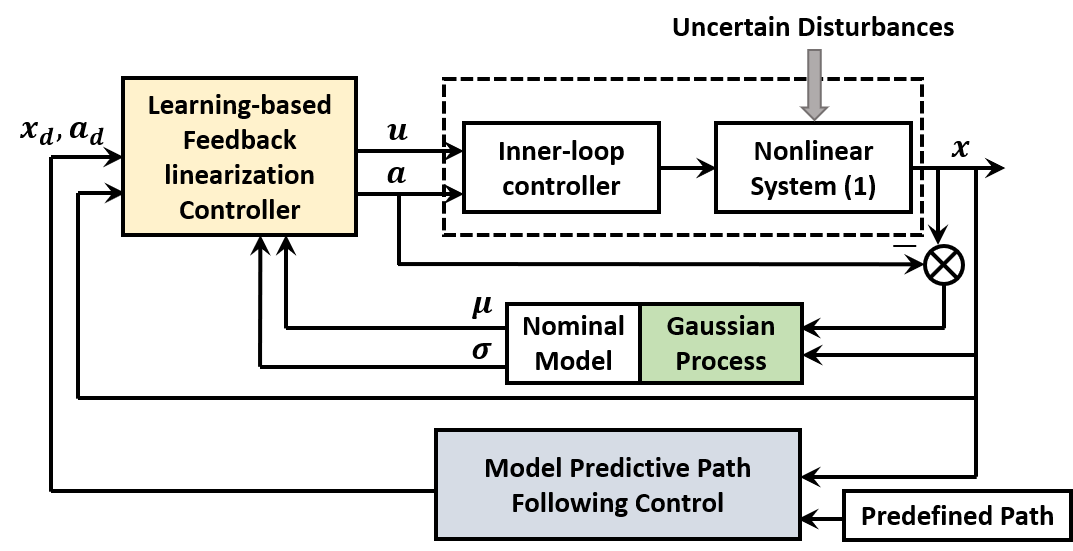
Learning-based MPFC that recovers reference tracking under non-stationary disturbances with safety guarantees.
Selected recent journal and conference papers
Collaborations, speaking invitations, and opportunities
